
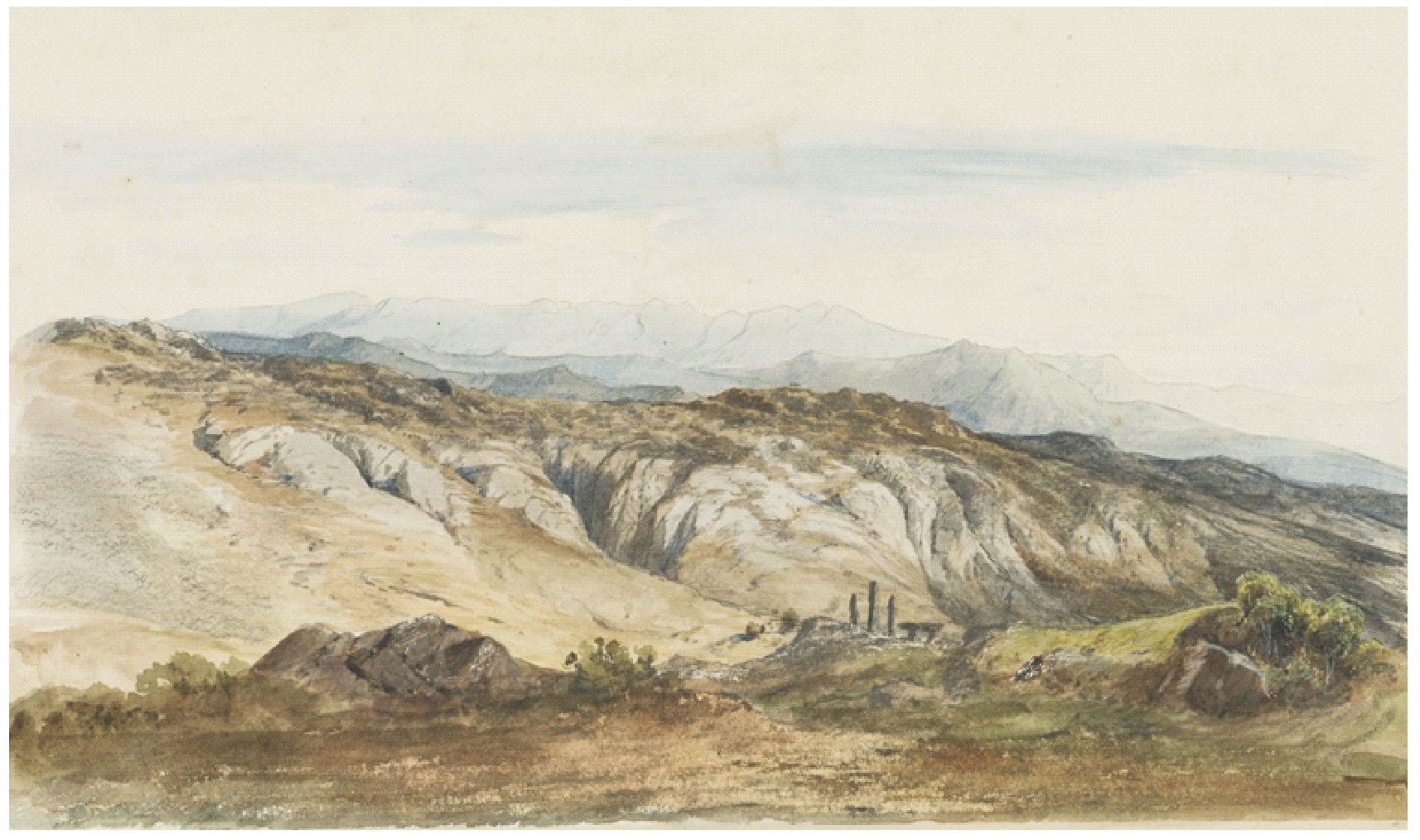
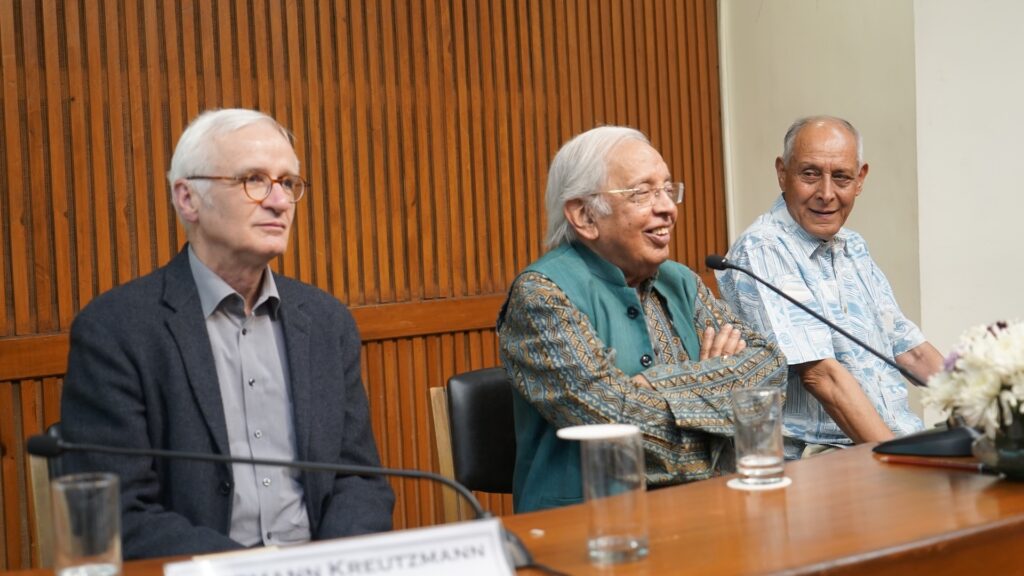
As part of the ongoing exhibition “Himalayan Encounters: Hidden Views from 170 Years Ago,” a special interactive session titled “Conversations on Schlagintweit Drawings” was held on April 22, 2026, at Lecture Room No. 2, Annexe, India International Centre, New Delhi.
The session brought together scholars, historians, and enthusiasts for an engaging and deeply insightful exploration of Himalayan history, art, and scientific discovery. It was chaired by noted poet, critic, and cultural thinker Ashok Vajpeyi.
Opening Remarks
The program began with a thoughtful introduction by Ankita Ojha, who welcomed the audience as “travelers of the mind,” setting the tone for an intellectual journey across time and terrain. She emphasized that the exhibition seeks to restore ways of seeing the Himalayas beyond mere mapping and measurement, presenting them instead as lived and experienced spaces. The audience was introduced to the German Schlagintweit brothers—19th-century explorers of High Asia—and Nain Singh Rawat, whose journeys across Tibet stand as remarkable examples of indigenous scientific exploration.
Message from Munich
Sabine read out a message from Stephanie Kleidt, curator at the Alpine Museum in Munich. The message highlighted that the museum had exhibited landscape watercolors and objects collected during the Schlagintweit brothers’ 1854–1857 expedition. Around 200 watercolors were donated by the family to the museum.
The idea of showcasing these works in India originated in 2015 when Shekhar Pathak visited Munich and came across a drawing of Nainital. During preparations for the current exhibition, an additional ten previously unknown drawings were discovered within the family’s collection, adding further depth to the archive.
Lecture by Hermann Kreutzmann
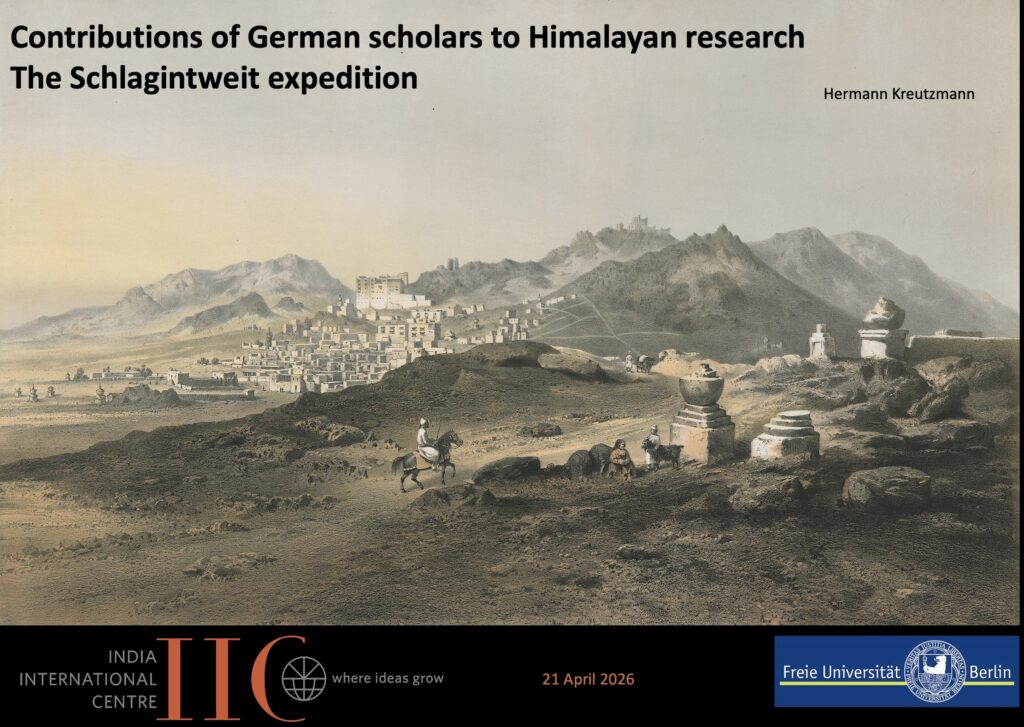
Hermann Kreutzmann (Freie Universität, Berlin) delivered a comprehensive lecture on “The German Role in Himalayan Understanding with Special Reference to Schlagintweit Brothers.” He traced the intellectual roots of German interest in the Himalayas back to Immanuel Kant, who, despite never traveling, lectured extensively on geography and considered Tibet a potential cradle of culture and science.
He also highlighted the influence of Alexander von Humboldt, whose global vision inspired the Schlagintweit expedition to India. Commissioned by the East India Company for a magnetic survey, the brothers went beyond their mandate to document glaciers, landscapes, and cultures across the Himalayan belt.
Their work resulted in nearly 750 sketches and paintings, of which 77 are featured in the current exhibition, spanning regions from Kashmir to Bhutan. The lecture also touched upon the tragic fate of Adolf Schlagintweit, who was killed in Kashgar during the expedition.
Lecture by Shekhar Pathak
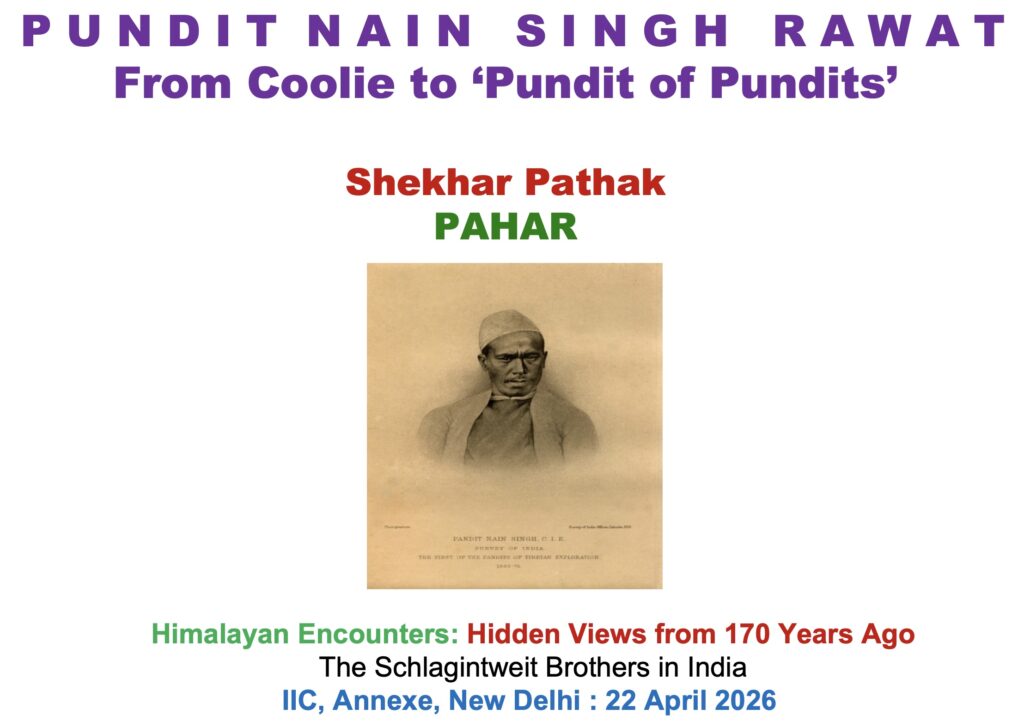
Shekhar Pathak spoke on “Remembering Nain Singh Rawat,” placing his life within the broader context of the Survey of India, established in 1767.
He recounted how Nain Singh Rawat, who initially worked as a porter for the Schlagintweit brothers, mastered surveying techniques and became one of the most accomplished indigenous explorers. As Tibet was closed to foreigners, he was among the “Pundits” trained by the British to secretly map the region.
His innovative methods included using a modified prayer wheel to conceal notes and a rosary with 100 beads to measure distance—every 2,000 steps marking a mile. His findings were later validated for their remarkable accuracy. He remains the only non-British recipient of the Patron’s Medal from the Royal Geographical Society and is remembered as the “Pundit of Pundits.”
Concluding Reflections
In his concluding remarks, Ashok Vajpeyi reflected on the profound influence of the Himalayas on global intellectual traditions. He noted how thinkers like Arthur Schopenhauer were inspired by the Upanishads, and how even Ludwig van Beethoven engaged with Vedic ideas in his writings. He emphasized that map-making is not merely a technical exercise but a deeply human endeavor shaped by risk, curiosity, and sacrifice.
Vote of Thanks
The session concluded with a vote of thanks by Chandan Dangi, who shared insights into the logistical challenges faced in bringing the exhibition to India. He mentioned hurdles such as customs regulations and the possibility of a duty amounting to nearly one crore rupees for transporting the antique artworks from Germany. He reiterated that the broader aim is to take these “hidden views” to a wider public audience.
Overall Impact
The session stood out as a rich confluence of history, art, exploration, and intellectual discourse. It was widely appreciated by attendees for its depth, scholarship, and engaging presentations, further enhancing the significance of the exhibition as a platform for revisiting the historical narratives of Himalayan exploration.
The session witnessed the participation of a wide range of curious minds and distinguished attendees, reflecting its strong intellectual appeal. Among those present were Justice Sudhanshu Dhulia (Retd.), Sanjiv Chopra and Shubhra Tandon from India International Centre, Bharat Bhushan and Rashmi Pant, noted writer Veer Bharat Talwar, as well as Pankaj Bisht, Dr. Harisuman Bisht, Bhupesh Joshi, Sunil Negi, Mahendra Latwal, Sanjay Joshi (Navarun), Khushhal Rawat, and Prakash Upadhyay. The gathering also included Vibhuti Sukhramani, Dr. Sanjeev Ranjan, Prof. Malishree Lal, Rashmi Rawat from University of Delhi, Russian language expert Hem Chandra, Kailash Pandey, and Vaishali. From academia, several faculty members and students from Jawaharlal Nehru University were present, including Prof. Saraindu Bhaduri (Science Policy Department), Prof. Sangeeta Dasgupta (History Department), and Lala Ram, a PhD scholar from the School of International Studies. The organizing team, including Chandan Dangi and Dr. Kamal Karnatak, was also actively present, contributing to the overall success of the event.
It must be have been a marvellous occasion once in a time in decades. I salute to your (Dangi ji) gigantic efforts in organising this great celebration on Himalayan region specially Uttarakhand part of it which has imprints of your physical excursions and rich experience. Keep it up.