
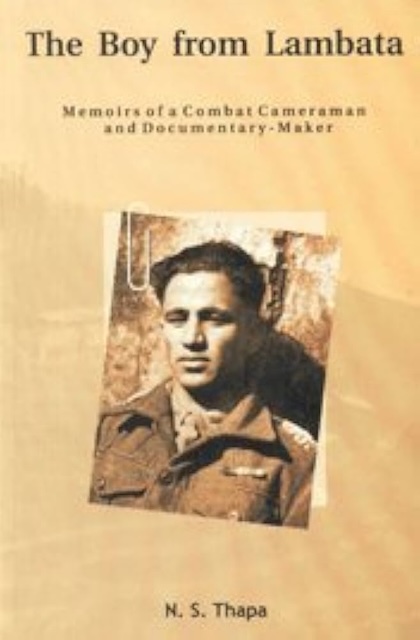
The Boy from Lambata: Memoirs of a Combat Cameraman and Documentary-Maker by N. S. Thapa is not just a personal memoir; it is a moving record of a man who saw India being shaped through the lens of a camera. Published in 2004 by PAHAR, the book presents the life of Narain Singh Thapa, a noted cinematographer, war photographer, and documentary filmmaker, and is listed as a 260-page biographical work focused on India.
What makes this book special is its viewpoint. Most histories are written by politicians, generals, administrators, or scholars. Thapa’s story comes from someone standing slightly behind the main stage of history—camera in hand—recording wars, national events, remote landscapes, official journeys, and the early decades after Independence. That gives the book a rare intimacy. It is history not as abstract policy, but as lived experience.
The book’s subtitle, Memoirs of a Combat Cameraman and Documentary-Maker, tells us why it matters. Thapa was not merely an observer; he was a visual chronicler of India’s public memory. A bookseller’s note describes the memoirs as telling not only the story of one man but also “how India was built during the first decades of freedom,” adding that Thapa was both witness and graphic chronicler of history.
For readers interested in cinema, documentary-making, photography, the armed forces, post-Independence India, or Himalayan lives, this book should be especially valuable. It offers a world that is rarely documented in popular writing: the discipline, danger, patience, and sensitivity required to film real events before digital convenience existed. A combat cameraman had to be technically skilled, physically brave, alert to history, and emotionally restrained enough to keep recording even in difficult moments.
The title itself—The Boy from Lambata—adds emotional pull. It suggests a journey from a small place to large historical spaces. That journey is often the most inspiring part of memoirs: how an ordinary beginning, shaped by hardship and curiosity, turns into an extraordinary life of national significance. A brief contemporary note about the book calls it an honest account of Thapa’s life, including his successes, failures, difficulties, and challenges.
This is also a book worth buying because such memoirs preserve material that can easily disappear. Documentary filmmakers and newsreel cameramen often create the images through which a nation remembers itself, yet their own names remain less known. Buying and reading this book is therefore not only a literary choice; it is a way of honouring a neglected profession and a remarkable Indian life.
The book may not be easy to find in every bookstore today, which makes it even more collectable.
Verdict: The Boy from Lambata is strongly recommended for readers who enjoy real-life stories with historical depth. It is useful for students of cinema, researchers of modern India, lovers of memoirs, and anyone interested in how one determined individual can travel from the margins of geography to the centre of history. This is not just a book to read; it is a book to preserve.
Please read another review here
One more review of the book.
For buying, please contact us.