
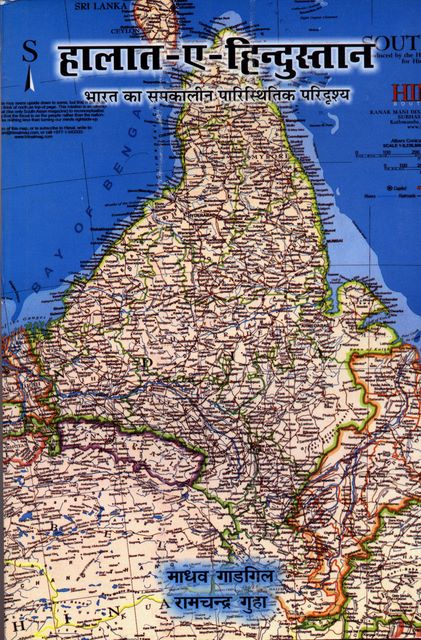
Contemporary environmental history of India.
Original English Title is Ecology and Equity : The use and Abuse of Nature in contemporary India (1995)
Original Author(s):Madhav Gadgil.
“Halat-e-Hindustan” by Madhav Gadgil and Ramachandra Guha (originally published as Ecology and Equity: The Use and Abuse of Nature in Contemporary India) is one of those rare books that doesn’t just inform you—it fundamentally changes how you see the country around you.
At first glance, it’s a work of environmental history. But very quickly, it becomes clear that this is also a powerful story about people, power, and the unequal ways in which India’s natural resources have been used—and often misused. Gadgil and Guha don’t treat forests, rivers, and land as abstract “resources.” Instead, they reveal how deeply these are tied to livelihoods, cultures, and survival, especially for communities who live closest to nature.
What makes this book so compelling is its clarity and courage. It traces how, over time, access to nature in India has shifted—from relatively community-centered systems to more centralized, and often exploitative, models. The authors lay bare the tension between development and sustainability without resorting to clichés. They ask difficult questions: Who benefits from development? Who pays the ecological price? And why do those who protect nature often have the least power?
Despite dealing with complex issues, the writing remains accessible and deeply engaging. The arguments are backed by careful research, yet never feel dry or academic. Instead, each chapter reads like a revelation, connecting historical patterns with the environmental challenges we see today—deforestation, water scarcity, industrial expansion, and social inequality.
What truly sets “Halat-e-Hindustan” apart is its relevance. Even decades after its original publication, its insights feel urgent and immediate. It equips readers with a lens to understand current environmental debates in India, making it not just a book to read, but a framework to think with.
This is essential reading for anyone who wants to understand India beyond headlines—students, policymakers, environmentalists, or simply thoughtful readers who care about the future of the country. It doesn’t offer easy solutions, but it gives something far more valuable: awareness, perspective, and the ability to ask the right questions.
If you’re looking for a book that is intellectually stimulating, socially meaningful, and deeply relevant, “Halat-e-Hindustan” is one you shouldn’t miss. It’s not just a study of the environment—it’s a mirror held up to modern India.
This book has been translated by Ashok Pandey the poet, translator, and the sketch creator.